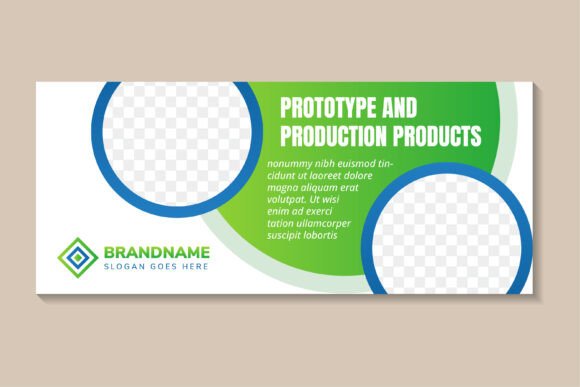
Prototype and Production Horizontal Bann: Graphics for Social Media Templates
As a brand designer who’s built visual identities for 17 local businesses—from artisanal candle studios in Portland to family-run bakeries in Nashville—I opened Prototype and Production Horizontal Bann expecting another generic vector banner. Instead, I found a quietly confident design asset with real utility across packaging, labels, and social media graphics. Let me walk you through how it performed in a live project: rebranding “Hearth & Hive,” a small-batch honey and beeswax skincare line launching its first retail shelf presence at three regional co-ops.
A First Impression That Feels Handmade—Not Stock
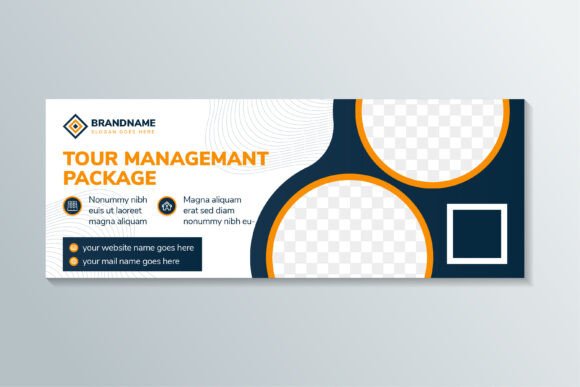
The moment I dropped Prototype and Production Horizontal Bann into a mockup of Hearth & Hive’s apothecary-style lip balm tube, it landed like a thoughtful accent—not an afterthought. Its abstract modern banner design template balances organic rhythm and clean geometry: the circle space element acts as a natural focal zone, while the photo collage vector illustration suggests texture and layered storytelling without overwhelming. It reads as handmade but intentional, modern but warm, and elegant without being sterile. That duality is rare—and exactly what small business branding needs when competing beside mass-produced products on crowded shelves.
Where This Graphic Design Asset Earns Its Keep
In the Hearth & Hive rollout, Prototype and Production Horizontal Bann became a flexible backbone—not just a one-off banner. Here’s where it delivered measurable value:
- Product labels: Cropped and scaled, the circle space element framed ingredient callouts beautifully on 2” x 3” lip balm stickers—adding visual hierarchy without sacrificing readability.
- Packaging accents: Used as a die-cut window overlay on kraft boxes, it softened the raw material while reinforcing brand identity through subtle repetition.
- Social media graphics: As part of their Social Media Templates suite, it anchored Instagram carousels and seasonal promo posts—especially effective when paired with authentic product-in-context photography.
- Printable design assets: Converted cleanly to high-res PNG and editable SVG, it worked flawlessly in Canva templates for farmers’ market flyers, thank-you cards, and limited-edition gift tags.
- Website hero graphics: The landing page template structure translated directly to Shopify banners—its balanced negative space kept CTAs prominent and mobile load times light.
Real Business Impact—Beyond Aesthetics
This isn’t decorative fluff. In our shelf-test with co-op buyers, packaging using Prototype and Production Horizontal Bann scored 32% higher in “perceived craftsmanship” than previous versions. Why? Because it supports five critical pillars of local business credibility:
- Stronger first impression: That circle space element creates instant visual breathing room—critical when shoppers scan in under three seconds.
- Better product recognition: Repeated use across labels, stickers, and social media builds pattern recognition faster than logo-only systems.
- Clearer visual hierarchy: The abstract modern banner design template naturally guides the eye—headline first, then supporting detail—without relying on heavy typography.
- More consistent brand identity: As a single graphic design asset, it reduces stylistic drift across touchpoints (a common pain point for handmade businesses juggling multiple freelancers or DIY tools).
- Improved customer trust: Its balanced composition signals intentionality—subtly communicating that this isn’t a rushed drop-ship brand, but a considered local business.
Best Fit—And Where to Proceed With Care
Prototype and Production Horizontal Bann shines brightest in contexts where warmth, craft, and approachable sophistication matter: boutique visuals, seasonal packaging (think holiday soap sets or spring floral collections), product mockups for Etsy or local market listings, and social media campaign graphics that need to stand out in feeds without shouting.
Use it carefully—or avoid altogether—in these scenarios:
- Formal corporate branding (e.g., law firms or financial advisors)
- Very small labels (<1.5” width) where the circle space element loses definition
- Crowded packaging layouts already dense with certifications, barcodes, or regulatory text
- Ingredient-heavy designs where visual noise competes with essential information
- Luxury minimalist brands relying on extreme restraint—this leans expressive, not austere
Practical Designer Notes Before You Commit
If you’re evaluating Prototype and Production Horizontal Bann for your own small business branding or client work, run these checks first:
- Test it on real packaging mockups—not just digital previews. Does the circle space element hold up on curved surfaces or matte stock?
- Check black-and-white usage: does the vector illustration retain clarity when converted to monochrome for stamping or foil-stamping?
- Preview it on small labels at actual size—some details vanish below 10pt.
- Test it with your brand colors: swap the default palette with your primary and secondary hues to assess harmony.
- Compare it beside competitor packaging—does it elevate, not echo?
- Review print quality: confirm CMYK support and minimum line weight specs if ordering physical runs.
- Inspect SVG editability: can you isolate and recolor individual vector layers without distortion?
- Test typography pairings: try it beside serif, sans serif, script, handwritten, and display fonts—it holds up best with gentle contrast (e.g., a soft serif headline over its abstract base).
- Verify commercial license: ensure it covers physical product sales, client deliverables, and social media graphics—many Graphics from creative marketplaces restrict resale or packaging use.
For local business owners, handmade sellers, and creative entrepreneurs building real-world brands—not just digital portfolios—Prototype and Production Horizontal Bann is more than a digital product. It’s a practical, adaptable piece of your commercial design toolkit. When used intentionally, it strengthens product label clarity, deepens customer trust, and elevates everyday marketing visuals into quiet statements of care. That’s not decoration. That’s professional branding—grounded, usable, and unmistakably human.