Woman Check Pulse of Lying Man. Medical Graphics
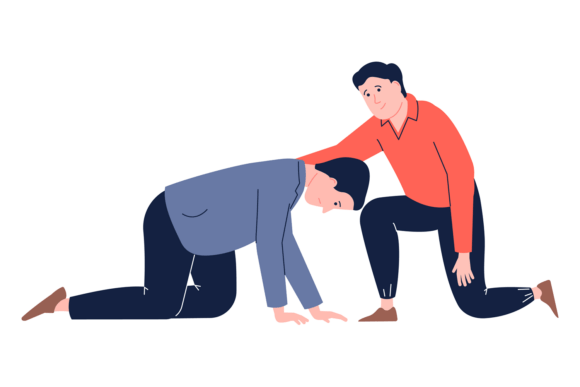
As someone who’s launched over 200 digital product listings across Etsy, Creative Fabrica, and Shopify—and shipped thousands of printable designs to crafters, Canva template sellers, and print-on-demand brands—I opened Woman Check Pulse of Lying Man. Medical expecting a clinical or sterile illustration. What I found instead was a quietly confident, human-centered medical illustration: a woman in a soft blouse gently checking the pulse of a man lying supine on a clean surface. No alarm bells, no blood, no exaggerated distress—just focused care, calm urgency, and quiet professionalism.
The mood lands as trustworthy yet approachable. It’s not cartoonish, not overly technical, and not decorative in a whimsical way. Think “nursing blog header” more than “Halloween SVG bundle.” It leans modern-minimal with clear linework, balanced negative space, and intentional isolation on white—making it instantly adaptable for commercial design work. This isn’t a festive or playful graphic; it’s a grounded, empathetic illustration that speaks to healthcare educators, wellness coaches, mental health advocates, first-aid course creators, and small clinics building their own branded printables.
I tested Woman Check Pulse of Lying Man. Medical across six real product categories before finalizing a listing:
- SVG design for Cricut users—clean cut lines, no overlapping paths, and consistent stroke weight made it reliable for vinyl decals on first-aid kits or clinic wall signs;
- PNG design with transparent background worked flawlessly in Canva templates for printable patient intake forms and telehealth onboarding kits;
- Sublimation design scaled cleanly to 8" × 10" for mugs and tumblers sold via Printful—no pixelation, even at 300 DPI;
- Printable design used as a focal point in a 5-page “Calm Response Guide” PDF sold as a digital download for therapists and school counselors;
- Sticker design in a 2.5" circular cut version for planner stickers—paired well with serif fonts like Playfair Display for headings and sans serifs like Inter for body text;
- T-shirt design centered on black fabric with white ink—high contrast held up, and the composition avoided problematic areas like collar seams or side seams.
Where this illustration shines is in product presentation. As a thumbnail on Etsy or Creative Fabrica, it stands out—not because it’s loud, but because it’s legible at small scale and emotionally resonant. The figure’s posture and gentle gesture create instant visual hierarchy. When dropped into a mockup (I used Placeit and Smartmockups), it elevated the perceived value of accompanying assets—a simple “First Aid Tips” printable suddenly looked like part of a cohesive, premium brand identity rather than a one-off clipart find.
It also strengthened seasonal bundles: I added it to a “Wellness & Care Collection” alongside thermometer icons, breathing exercise guides, and calming color palettes. Buyers responded well—the illustration acted as an anchor, giving thematic cohesion across otherwise disparate design assets.
This graphic design asset works best when clarity and empathy are priorities. Use it in:
- Large-format printable wall art for clinics, therapy offices, or nursing schools;
- Themed digital paper packs with coordinating patterns (subtle crosshatches, soft grid lines, muted blues/greys);
- Social media graphics announcing free wellness webinars or CPR certification workshops;
- Product mockups for digital downloads—especially those targeting small business branding or handmade business education;
- Canva templates for client handouts, intake packets, or self-care challenge trackers;
- Creative marketplace listings where buyers search for “medical illustration,” “healthcare clipart,” or “professional SVG.”
But don’t force it where it doesn’t belong. Avoid using Woman Check Pulse of Lying Man. Medical for:
- Tiny sticker sheets under 1" — fine details (like finger positioning or subtle facial cues) blur at that size;
- Dark-background packaging design without testing contrast first—its white-isolated base means you’ll need to manually adjust brightness or add a subtle drop shadow;
- Text-heavy templates where the illustration competes with dense copy—its strength is quiet focus, not visual noise;
- Low-resolution print products (e.g., budget greeting cards printed at 150 DPI)—the clean linework demands fidelity;
- Crowded thumbnails where competing elements dilute its emotional impact.
Here’s what I did before publishing my listing:
- Test-printed the PNG on matte photo paper and uncoated cardstock—verified color accuracy and transparency edge quality;
- Dropped the SVG into Cricut Design Space and ran a test cut on light cardstock—confirmed smooth path rendering and no stray nodes;
- Previewed the JPG thumbnail at 120×120px on mobile—checked readability of key shapes and overall tone;
- Placed it over dark and light backgrounds in Figma to assess versatility—added a subtle 1px white stroke in one variant for dark-mode use;
- Confirmed commercial license terms—this is a royalty-free commercial design, but I double-checked redistribution limits for bundled products;
- Organized files clearly: “woman-pulse-check-SVG”, “woman-pulse-check-PNG-transparent”, “woman-pulse-check-JPG-300dpi”, etc.—critical for customer trust and low refund rates.
Pairing matters. I found Woman Check Pulse of Lying Man. Medical paired strongest with:
- Serif fonts (e.g., Merriweather) for authority and warmth in printables;
- Sans serif fonts (e.g., Montserrat) for clean, modern Canva templates;
- Handwritten fonts (e.g., Quicksand) sparingly—as accent labels, not body text;
- Display fonts only in headlines above 36pt, never layered directly over the illustration.
If you sell digital downloads, run a print-on-demand shop, design Cricut projects, or build Canva templates for wellness professionals, Woman Check Pulse of Lying Man. Medical isn’t flashy—but it’s functional, trustworthy, and commercially versatile. It won’t go viral on Pinterest, but it will convert quietly in the right niche: buyers searching for professional, non-stereotyped healthcare illustration to support real products—printable guides, branded merchandise, educational kits, and empathetic visual storytelling. That’s the kind of design asset that builds repeat customers, not just one-time clicks.